
Your clients are pasting your advice into ChatGPT
Clients are sending lawyers "17 pages of AI drivel," and those chats may end up in discovery. Here's the 10-minute engagement-letter fix, the one AI plan worth paying for, and the cite-check habit that keeps you out of sanctions.
LinkedControls field report · October 22, 2026 · Free
Your clients are pasting your advice into ChatGPT, then arguing with you about it. One lawyer's client sent "17 pages of AI drivel," then "believed AI over me."
Here's the short version. Your biggest AI risk this year may be your clients' tools, not yours. Tonight, add one paragraph to your engagement letter and one question to intake, then put your own AI work on one business-grade plan.
We read what solo and small-firm lawyers say on Reddit and X, plus recent court rulings and bar guidance. This is general information, not legal or ethics advice. Ask your ethics counsel or state bar before you change your engagement letter.
Do this tonight (10 minutes): open your engagement letter template. Paste this under the section on communication, and change the bracketed part to fit your fee:
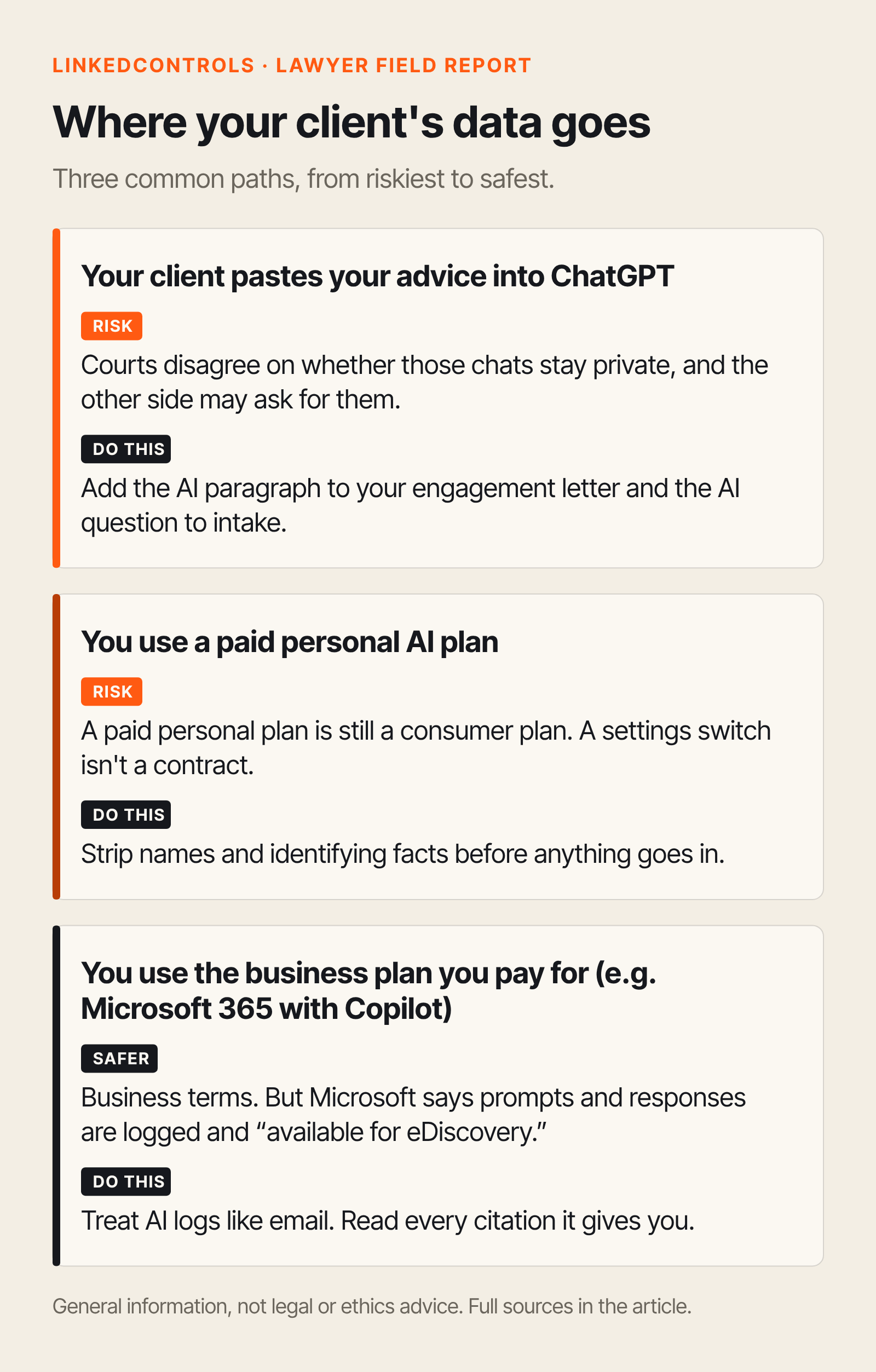
AI apps and your case. Please don't paste our emails, drafts, or facts about your matter into ChatGPT, Claude, Gemini, or any other AI app. Please keep AI note-takers off our calls. Courts disagree on whether those chats stay private, and the other side may ask for them. If you send me questions or drafts written by AI, my time reviewing them is billed at my hourly rate [or: is outside the flat fee]. I'm always glad to answer questions you write in your own words.
Then add one question to your intake form: "Have you used ChatGPT or another AI tool to discuss this matter, or recorded our calls with an AI note-taker? If yes, which tool and when?" Ask your ethics counsel whether the billing line fits your state's fee rules.
1. Your clients' AI chats may be evidence
An estate-planning lawyer described "clients sending novella-length emails to me with 500 questions and suggested language… We charge a flat rate on our documents." Another said clients who don't like their bill "run it through ChatGPT," then send its response "asking me to defend XYZ."
In February, Judge Rakoff (S.D.N.Y.) ruled that a client's Claude chats about his own case were not privileged. Other courts disagree.
In June, a Texas business court said a party's ChatGPT chats can be protected work product, siding with two federal courts. Even so, it ordered some chat pages turned over. It also made the party list every discovery document it had shared with ChatGPT.
The law is split, and lawyers on the other side are already asking. "I've been requesting these in discovery and its been great," one wrote.
What this means for you: warn clients in writing at the start, and bill the time it takes to answer AI drafts. One lawyer wrote: "You'd be amazed how practical people get when they have to pay to be impractical."
2. Paying for ChatGPT doesn't make it private
Lawyers keep asking: "Why is the paid version a risk if there's a setting that says that they don't train models on it?"
- A paid personal plan is still a consumer plan. In 2025, a court order in the New York Times case forced OpenAI to keep chats from ChatGPT Free, Plus, Pro, and Team. OpenAI said the order did "not impact ChatGPT Enterprise or ChatGPT Edu customers." That order ended Sept. 26, 2025.
- A settings switch isn't a contract. As one r/LawFirm commenter put it: "Turning training off in product settings is not the same thing as a contract that says the provider cannot keep or train on what hits the connector."
Our pick: Microsoft 365 Business Standard with Copilot. Why it wins: AI sits inside Word and Outlook under Microsoft's business terms, with no new app, and it works for one seat. We have no affiliate deal with Microsoft or Google.
It's $23.50/user/mo, paid yearly (auto-renews; some advanced AI features bill extra by usage), so $70.50/mo for 3 people or $23.50 solo (microsoft.com, checked Oct 22, 2026). Setup time: we didn't time it, but if you're already on Microsoft 365 it's a plan change, not a migration. What you still do: read every citation it gives you.
Backup if you're on Gmail: Google Workspace Business Standard with Gemini. It's $14/user/mo, billed monthly, so $42/mo for 3 people (workspace.google.com/pricing, checked Oct 22, 2026). New customers may see up to 50% off the first 3 months.
ChatGPT Business and Claude Team each need at least 2 seats, at $25/seat billed monthly. They're fine, but they're one more app holding client data.
3. Fake citations are mostly a solo problem
Stanford researcher Riana Pfefferkorn studied 114 court cases with AI-tainted filings. Of the firms involved, "90% – are either solo practices or small firms."
Paying more didn't help. In Flycatcher v. Affable Ave. (S.D.N.Y.), counsel "submitted his brief to three rounds of review by AI programs," and 14 of his 60 cited cases were fake by his own count. The court ordered him to pay the opposing lawyer who reported him $38,877.59.
One court said counsel must also do "a basic cite-check of the cases cited by the other side." In California, SB 574 was signed Sept. 30, 2026, and takes effect Jan. 1, 2027. According to summaries by Ropes & Gray and Arnold & Porter, a filing can't contain any citation the responsible lawyer "has not personally verified."
The habit: open every case you cite, and read the page you quote. Spot-check the cases in your opponent's brief.
Keep client data safe
- Client facts go only into the business plan you pay for. Anywhere else, strip names and identifying facts first.
- You may need informed consent before client information goes into an AI tool. ABA Formal Opinion 512 adds that "merely adding general, boiler-plate provisions to engagement letters… is not sufficient."
- Treat AI logs like email. Microsoft says Copilot prompts and responses are logged and "available for eDiscovery."
- Bill real time, not saved time. Michigan's example: charge 15 minutes, not "approximately three hours." Don't bill clients for learning the tool.
What to ignore
- A blanket "no AI" ban for clients: lawyers say clients dodge it by "claiming that 'it's not AI,'" so bill the review instead.
- "AI checks the AI" cite-checkers: three rounds of AI review didn't save the Flycatcher lawyer.
- Enterprise legal AI pitches: if the price says "talk to sales," you don't need it yet.
The takeaway
- Tonight: add the client AI paragraph and the intake question.
- This week: move your own AI work onto the business plan of the suite you already pay for.
- Every filing: open every case you cite, and spot-check the other side's.
Some links may be affiliate links. We pick tools before we check commissions.
Sources
Opened and checked Oct 22, 2026.
Lawyers in their own words - r/Lawyertalk, novella-length client emails; "pay to be impractical" (Feb 21, 2026): reddit.com/r/Lawyertalk/comments/1rac4ep - r/Lawyertalk, "17 pages of AI drivel," bills run through ChatGPT, discovery requests, "it's not AI" (Jul 31, 2026): reddit.com/r/Lawyertalk/comments/1vbtl78 - r/LawFirm, "Turning training off…" (Sep 7, 2026): reddit.com/r/LawFirm/comments/1wa3drg - r/LawFirm, "Why is the paid version a risk…" (Jul 10, 2026): reddit.com/r/LawFirm/comments/1usbc96
Courts and rules - US v. Heppner, No. 1:25-cr-00503 (S.D.N.Y. Feb 17, 2026): order - Tate Group Automotive v. Legacy Automotive Capital, No. 25-BC11B-0020 (Tex. Bus. Ct., June 3, 2026): court copy · Foley & Lardner summary - Flycatcher v. Affable Ave., No. 24-cv-9429 (S.D.N.Y.): sanctions opinion, Feb 5, 2026 · fee opinion, Oct 9, 2026 - ABA Journal, judges faulting lawyers who miss opponents' fake cites (Oct 1, 2026): abajournal.com - Stanford CIS, "Who's Submitting AI-Tainted Filings in Court?" (Oct 15, 2025): cyberlaw.stanford.edu - California SB 574 (Ch. 858, Stats. 2026): CapitolTrack · Ropes & Gray · Arnold & Porter
Ethics guidance - ABA Formal Opinion 512 (July 29, 2024): mirror copy - State Bar of Michigan, AI FAQs: michbar.org
Data and prices - OpenAI, response to NYT data demands: openai.com - Microsoft 365 Business Standard with Copilot · Google Workspace pricing · ChatGPT Business · Claude Team